
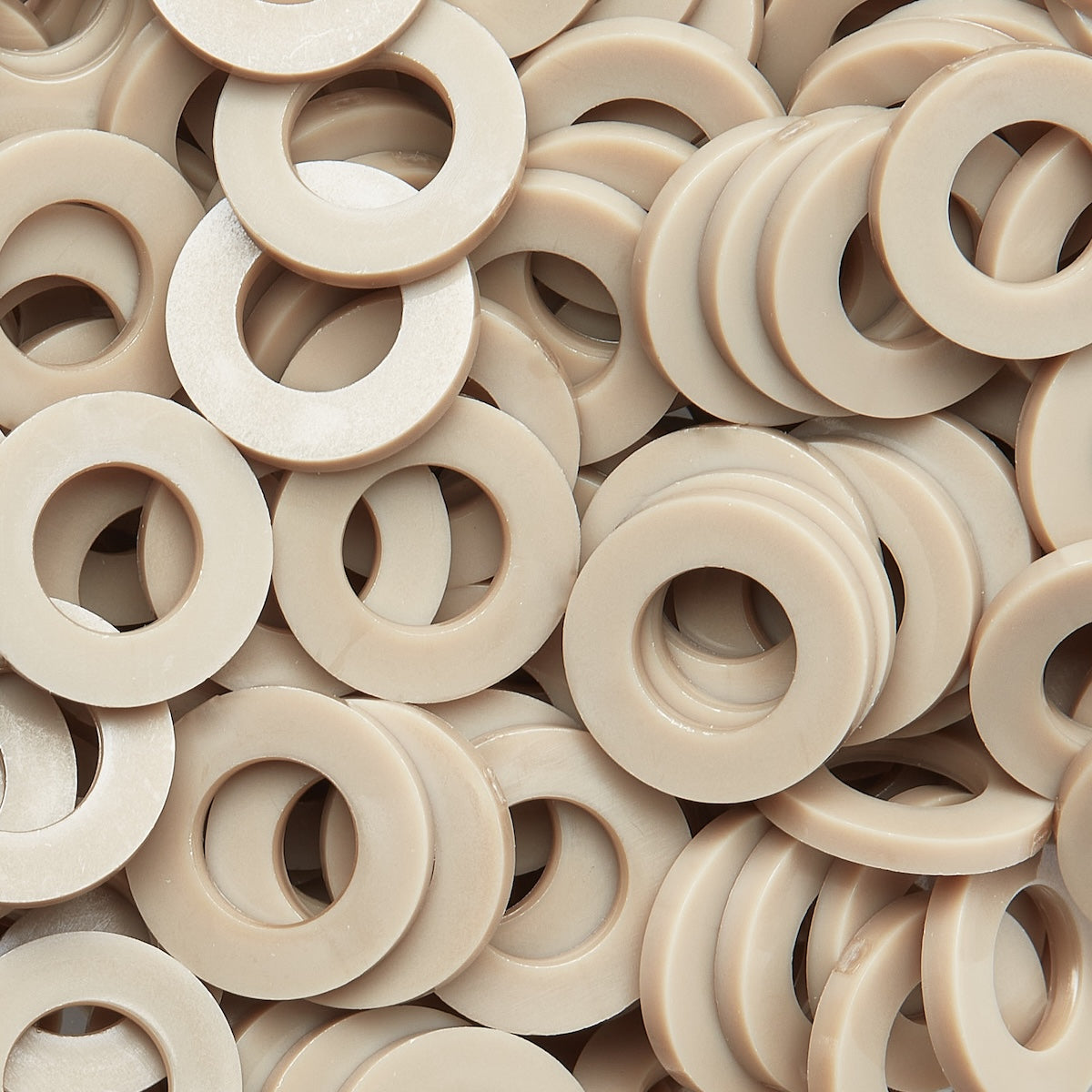
Water jet cutting is a subtractive manufacturing process that uses a narrow, high-pressure stream of water to cut material along a computer-controlled path. For harder materials such as metal, stone, and engineering plastics, an abrasive—typically garnet—is mixed into the stream to increase its cutting power; pure water jets are used for softer materials. The jet removes material by erosion, producing a narrow cut known as a kerf. Because the process does not rely on heat, it avoids the heat-affected zone associated with thermal cutting methods. Cut quality and accuracy depend on factors such as water pressure, abrasive flow, nozzle condition, material thickness, and cutting speed.
Water Jet Cutting
This page discusses one of our manufacturing methods: water jet cutting. If you have any questions or need a quotation for a custom component, click this button:
Which materials can be Water Jet Cut?
Suitability varies for each method and material
Can be water jet cut
-
Polyacetal (POM), polyether ether ketone (PEEK), polyamide (PA), polyetherimide (PEI), polycarbonate (PC), polyphenylene sulphide (PPS), polyimide (PI), polyvinylidene fluoride (PVDF), polyvinyl chloride (PVC), polyethylene (PE), polypropylene (PP), polytetrafluoroethylene (PTFE), perfluoroalkoxy (PFA)
All these unfilled plastic sheets are well suited to water jet cutting. If a sheet is excessively thin or flexible extra support may be needed.
-
PEEK GF30, PA66 GF60, RENY MXD6
These glass fibre-reinforced materials require an abrasive water jet cutting and a trial cut to check their edge for any exposed fibres.
-
Ceramic alumina (Al₂O₃), ceramic zirconia (ZrO₂)
These materials require support to avoid cracking and chipping.
